
QUANTIFIED VALUE
AI time-slicing: turning arc-on ÷ power-on into a trustworthy welding utilization figure
SUXIN Academy · ~5 min read
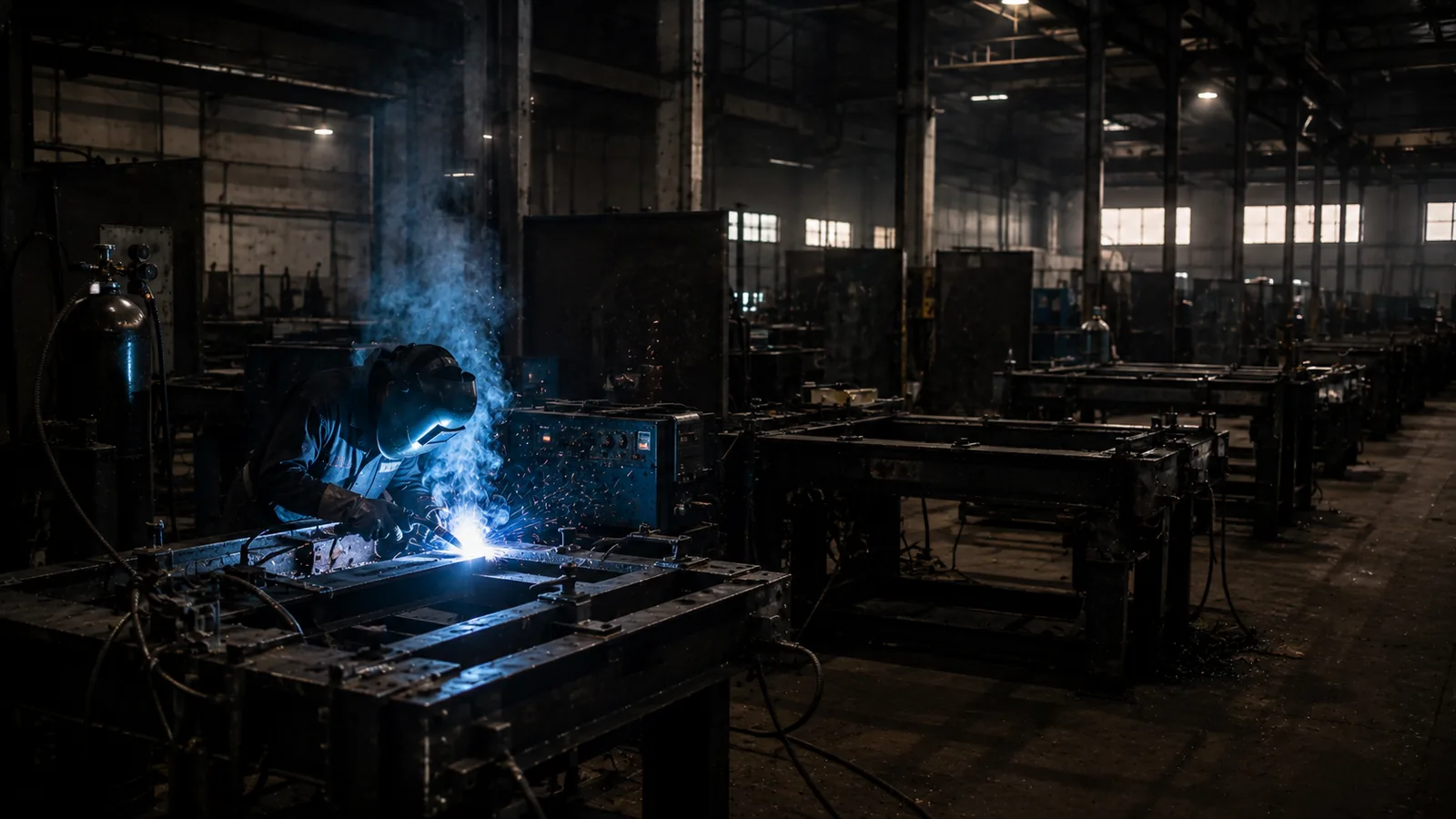
The most common mistake in gauging welding capacity is to look at “how many welders were switched on, and for how many hours.” But within that power-on time, only a fraction is actually spent welding with the arc struck; the rest is consumed in preparation, waiting, adjustment and idling.
A more objective indicator is arc-on time ÷ power-on time — the share of each unit of power-on time truly spent welding, commonly called welding utilization (OEE). It removes the padding of “powered-on but not welding” and reflects how effectively the equipment is really being used.
To obtain this indicator, you need to capture each welder’s arc-on and power-on state by the second, compute OEE automatically, and separate the two kinds of time — welding versus powered-on but not welding — on a dashboard. Managers can then see which stations and which time periods the loss concentrates in, and improve scheduling and line balancing accordingly, rather than attributing it vaguely to “not enough people, not enough machines.”
The value of this measure lies not in monitoring individuals but in providing an objective basis for scheduling and incentives — replacing impressions with data, and raising overall output without adding equipment.
Going further, smart welding does not stop at collecting data; it also runs statistical analysis on top of the data to form objective indicators such as OEE — and this step cannot be done without AI. With the current signal alone, you still cannot tell whether a given moment is welding with the arc struck, idling at no load, or an abnormal interruption; AI uses time-slicing to classify the continuous signal, slice by slice, into these three categories, only then yielding an accurate arc-on ÷ power-on — with no need for human watching, and with a unified measure across brands and across equipment of different ages, further pinpointing losses and aiding scheduling. Only by reading the raw data can you speak of a trustworthy OEE.
OEE deserves to be taken seriously because it corresponds directly to hard money. Take a welding enterprise with about ¥100 million in annual output value: with the same equipment and welding team, a utilization gain of about 10% lets the same line create about ¥10 million more output value a year (roughly a tenth of the original output value), which by typical profit margins can translate into several million yuan of profit. Capacity often comes not from piling on equipment, but from first measuring and then raising the utilization of the equipment you already have.
Suxin has long focused on smart welding; its welding data acquisition, AI time-slicing and capacity dashboards are proven on leading lines, and it holds 70+ invention patents. To measure your welding utilization objectively, book a capacity-dashboard demo.